
Constraints-Led Coaching Without the Buzzwords

Transcript
SLIDE 1 — CONSTRAINTS-LED COACHING: WITHOUT THE BUZZWORDS
Have you ever spent a training session telling your players to spread out, only to watch them crowd around the ball again a few seconds later?
You stop the game. You explain it again. Everyone nods. Then the game restarts, and the same thing happens.
If that sounds familiar, this video is for you.
We’re going to explore a simple way to help players learn through the practice itself. It’s called constraints-led coaching.
The name can sound more complicated than the idea actually is.
You make a small change to the game, then watch how your players respond. That change might involve the size of the playing area, a scoring rule, or the number of players on each team.
The aim is to create situations that encourage the behavior you want to see.
You still coach. You still explain, encourage, and help. But the activity gives your players more opportunities to work things out while they’re playing.
Let’s look at how that works.
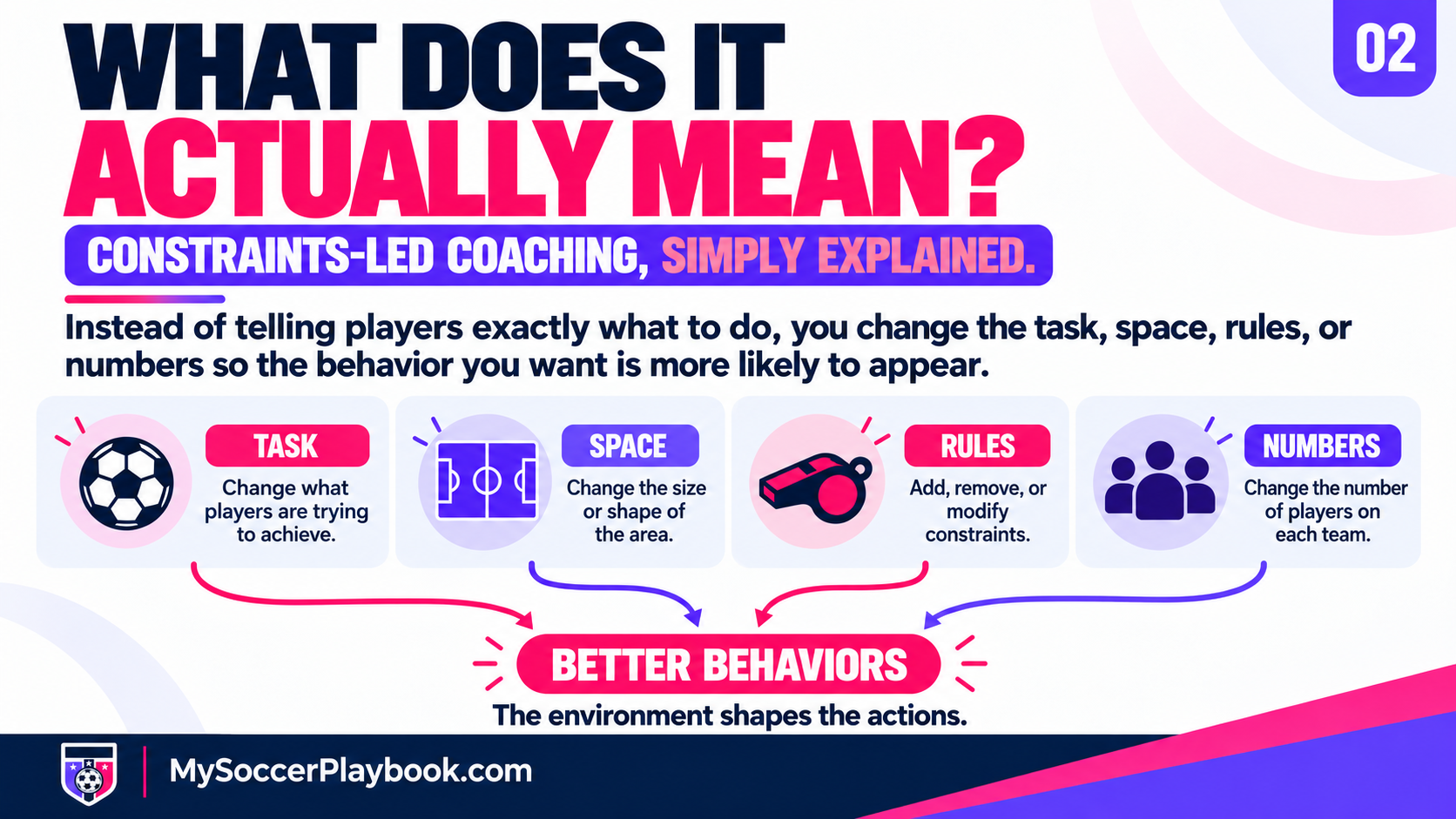
SLIDE 2 — WHAT DOES IT ACTUALLY MEAN?
A constraint is simply something that shapes the choices available to a player.
Soccer already has plenty of them. There are boundaries, opponents, teammates, goals, and rules about what you can do with the ball.
All of those things influence how players behave.
As a coach, you can adjust some of those conditions during practice.
Look at the four categories on this slide.
The task is what the players are trying to achieve. Are they keeping possession, scoring in a goal, or carrying the ball into a particular area?
Space means the size or shape of the playing area.
Rules are the conditions you add, remove, or change.
Numbers means how many players are involved, and how they’re divided between teams.
Imagine your team struggles to keep possession. In an equal-number game, the player with the ball might get surrounded before they can spot a pass.
You could add a supporting player who always helps the team in possession.
Now there’s an extra passing option. Your players have an opportunity to find that option and use it.
That doesn’t guarantee better decisions. You still need to observe what happens.
But you’ve changed the environment in a way that can make the behavior you want more likely.
SLIDE 3 — SMALL CHANGES, DIFFERENT BEHAVIORS
Let’s look at three examples.
First, smaller space.
When you reduce the playing area, opponents can often reach the ball more quickly. Players may need to look around earlier, take a useful first touch, and make decisions sooner.
But smaller isn’t automatically better.
If the area becomes too tight, players might have no realistic options. You could end up with constant collisions, rushed kicks, and very little learning.
The useful question is whether the space creates a challenge your players can manage.
Next, directional targets.
A possession activity asks players to keep the ball. Adding goals or end targets gives them a reason to move it somewhere.
Now they need to recognise when they can play forward, and when they need to keep possession while another opportunity develops.
Finally, wide channels.
Marking areas along the sides of the pitch can help players notice space away from the crowd.
A scoring condition involving those areas can give them a reason to use that width.
Across all three examples, the coaching principle is the same.
Change something about the game, then check whether it encourages the behavior you intended.
SLIDE 4 — WHAT CAN YOU CHANGE?
Here are four useful things you can adjust when planning a practice.
Start with space.
You can make the area wider, narrower, longer, or shorter. You can also mark zones within it.
Think about the problem your players are facing. If they’re constantly crowded, a wider area might give them a better opportunity to recognise and use space.
Next, rules.
You can change how teams score, introduce a condition, or remove a restriction that’s getting in the way.
Be careful with touch limits, particularly with beginners. A player who’s still learning to control the ball may need several touches before they can make a useful pass.
Then there are numbers.
You can create an overload, where one team has more players than the other. Or you can add a neutral player who supports whichever team has possession.
That can change the passing options available and the difficulty of keeping the ball.
Finally, targets.
These might be normal goals, smaller goals, end zones, or wide channels.
Different targets give players different problems to solve.
You don’t need to change all four things at once. Start with one variable. It will be much easier to understand what difference your change has made.
SLIDE 5 — ONE PRACTICE, DIFFERENT OUTCOMES
Imagine you’ve set up a small-sided game with two teams and a goal at each end.
You can keep that basic practice and change the learning focus.
Let’s take the four examples on the slide.
First, add wide channels.
You could offer a bonus point for a goal scored after the team has used a wide channel during the attack.
That gives players a reason to look towards the sides of the pitch.
Watch whether they’re using the width to create better options, rather than simply visiting the channel to satisfy the rule.
Second, add end zones.
Instead of scoring into a goal, a team might score when a player receives a pass inside the opposition’s end zone.
This can encourage players to move beyond defenders and teammates to look for those runs.
Watch for players standing in the zone waiting. If that happens, you could require the receiver to move into the zone as the pass is played.
Third, win it back in five seconds.
You could reward a team with a bonus point if they regain possession within five seconds of losing it.
The aim is to encourage a quick reaction after the ball changes hands.
Watch the whole team, though. If everyone charges at the ball and leaves opponents unmarked, the activity may need adjusting.
Fourth, add a neutral player.
This player supports the team in possession, creating an extra passing option.
That can help players experience how support makes it easier to keep the ball.
One basic game. Four different changes. Each creates a different learning opportunity.
SLIDE 6 — WHEN IT GOES WRONG
Constraints only help when they match what you’re trying to teach.
There are four common problems to watch for.
The first is too many rules.
Imagine explaining that players can only take two touches, must pass through a wide channel, need five passes before scoring, and have to win the ball back within five seconds.
For a beginner, remembering all of that can become the main task.
Start with one clear condition. Give the players time to experience it.
The second problem is encouraging the wrong behavior.
Suppose you want players to recognise a chance to attack, but your rule says they must complete five passes before they can score.
A player might see a teammate free in front of goal and ignore them because the team hasn’t reached five passes yet.
The rule is now working against your objective.
The third problem is losing realism.
A practice can become so restricted that players spend their time finding ways around the rules instead of responding to normal soccer situations.
Ask yourself whether the activity still involves useful decisions about the ball, opponents, teammates, and space.
The fourth problem is confusion.
If players keep stopping to ask what they’re allowed to do, simplify the task.
That doesn’t mean you’ve failed. Their response is information you can use to improve the practice.
SLIDE 7 — HOW SHOULD YOU USE IT?
Here’s a simple process you can use at your next session.
Step one: start with a behavior.
Be specific about what you want to see.
“Better soccer” is difficult to observe. “Players offering a passing option away from the crowd” gives you something much clearer to look for.
Step two: add one simple constraint.
Choose a change that might encourage that behavior.
For example, if you want players to offer more support, you could add a neutral player. Explain who that player helps, demonstrate briefly if needed, and get the game moving.
Step three: watch the response.
Give players enough time to experience the problem. Try to resist stopping the game after every mistake.
Look for patterns.
Are players finding the neutral player? Are they moving to offer the next pass? Are more players becoming involved, or is one confident player doing everything?
Those observations tell you much more than whether the activity looks busy.
Step four: adjust if needed.
If players have no time to recognise an option, you might make the area slightly bigger.
If they’re finding it too easy, you could reduce the space a little or change the numerical advantage.
You can also ask a short question, such as, “Where could you move to help the player with the ball?”
Then let them try again.
There’s still a place for a clear explanation or a quick demonstration. The goal is to help players understand the problem and return to playing.
You don’t need to predict every outcome before you start. Choose a sensible change, observe carefully, and adapt.
SLIDE 8 — KEY TAKEAWAY: DON’T COACH THE ANSWER. DESIGN THE PROBLEM.
The main takeaway is simple.
You don’t have to provide the answer to every situation your players face.
You can design a practice that gives them useful problems to solve, then support them as they explore possible solutions.
That creates opportunities for more discovery and more decisions.
It can also support better transfer into matches, especially when the practice keeps the important features of soccer: teammates, opponents, direction, and meaningful choices.
For your next session, choose one behavior you’d like to see more often.
Make one small change to the game.
Then watch what your players actually do.
Keep what helps. Adjust what doesn’t.
Constraints-led coaching doesn’t require complicated language or a huge collection of special rules.
It requires a clear purpose, a useful activity, and a coach who pays attention.
Your role is still essential. You’re creating the conditions for learning, helping when it’s needed, and giving players room to become more capable decision-makers.